Types Of Heat Exchangers: Air-Cooled, Plate And Shell-And-Tube
Knowledge base
A heat exchanger moves heat from one fluid to another without mixing them. That one sentence covers a radiator on a truck, the condenser in a refrigerator and the steam generator of a power station, and the engineering lies in how the two fluids are brought together. Three families do most of the work in power generation and industry: the air-cooled heat exchanger, where the second fluid is the atmosphere; the plate heat exchanger, where two liquids meet across thin pressed plates; and the shell-and-tube heat exchanger, where one fluid flows through a bundle of tubes and the other around them.
This guide explains each type, what it is good at, and how an engine cooling system uses all three.
Air-Cooled Heat Exchangers: Finned Tube Coils And Fans
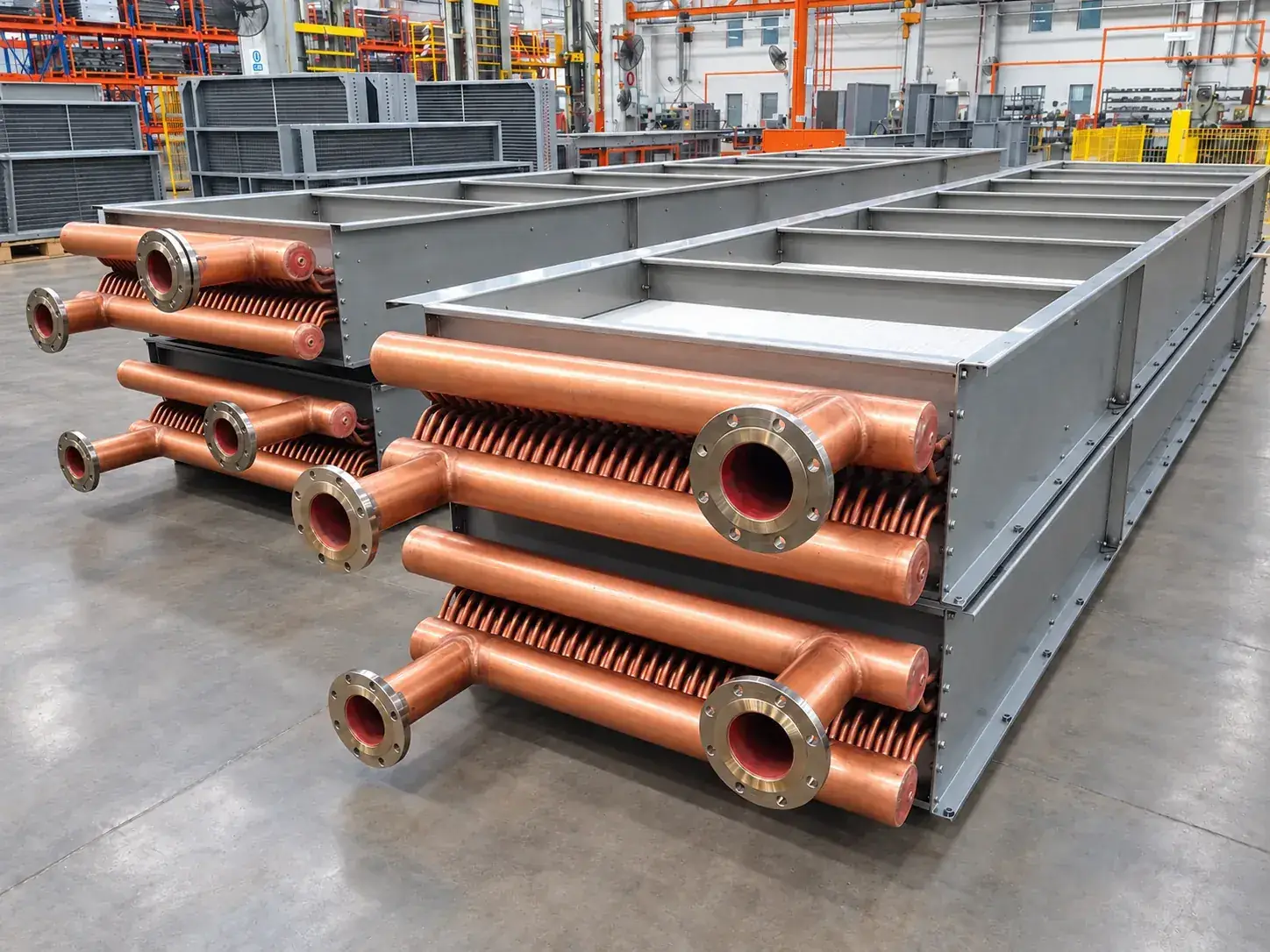
When the heat has to end in the atmosphere, the air is the second fluid, and air is a poor conductor with a low heat capacity. The air-cooled heat exchanger compensates with surface: a finned tube coil puts a large area of thin aluminium fins into the air stream, and fans move the air through them. Radiators, dry coolers, air-cooled condensers and gas turbine inlet coils are all of this family.
Its strengths are independence - no water, no second circuit, no pump - and robustness. Its limits are the ambient temperature, which it can never cool below, the space the coil face needs, and the fan noise, which the design controls with fan choice and speed. It is the final stage of every engine cooling system and the TECS product line.
Plate Heat Exchangers: Liquid To Liquid In A Small Space
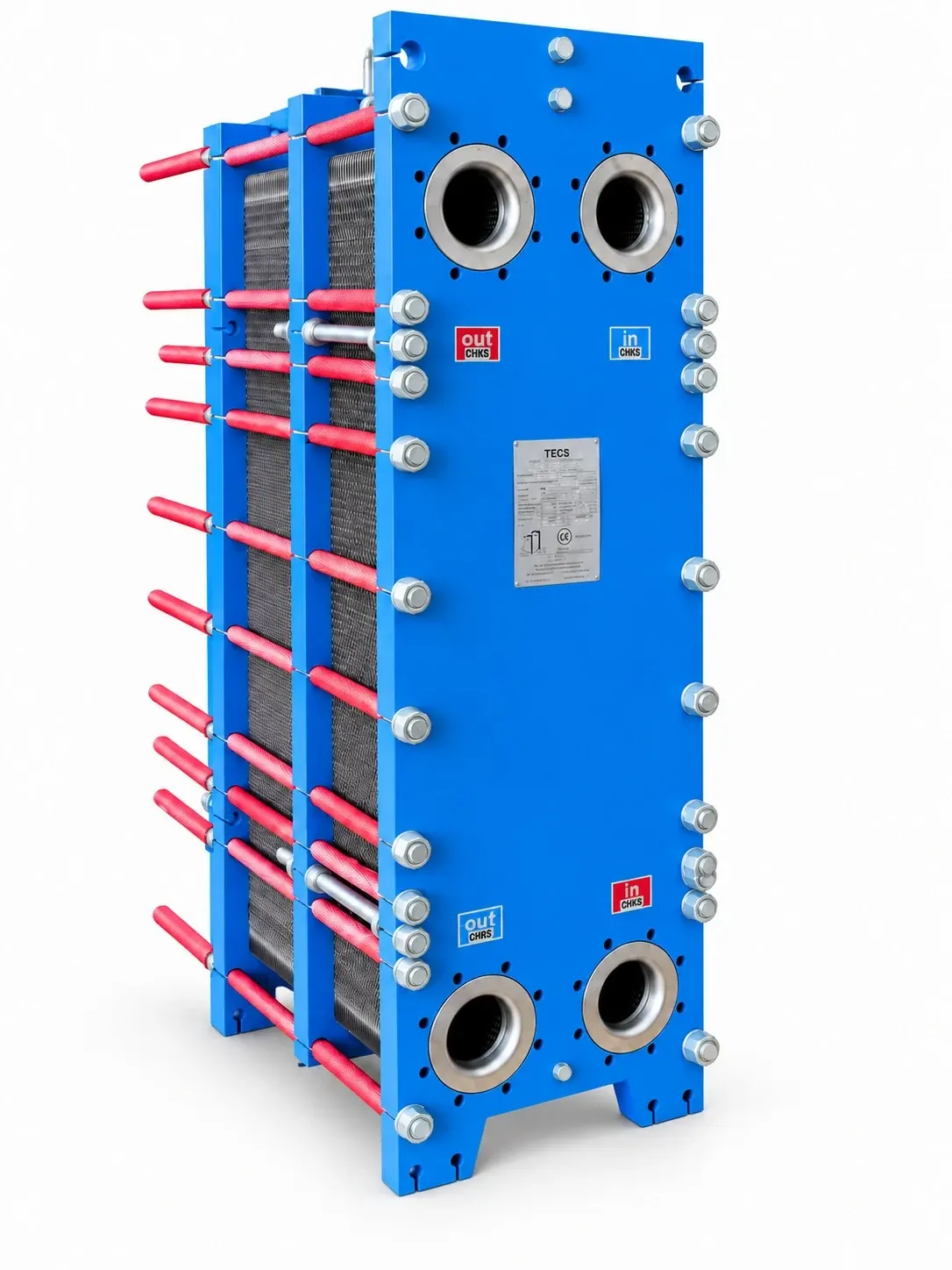
A plate heat exchanger is a stack of corrugated stainless steel plates, gasketed or brazed, with the two liquids flowing in alternate channels. The corrugations make the flow turbulent and the plates are thin, so the heat-transfer coefficients are high and the unit is compact: a plate exchanger for a given duty is a fraction of the size of a shell-and-tube unit. Gasketed units can be opened and extended; brazed units are sealed and cheaper.
They serve wherever two liquids exchange heat at moderate pressure and temperature: separating a raw-water circuit from the engine coolant, recovering heat from a CHP engine into a heating network, cooling lubricating oil with coolant. Their weak points are fouling in narrow channels, gasket limits on temperature and chemicals, and the pressure drop that the narrow channels cost.
Shell-And-Tube: The Heavy-Duty Standard
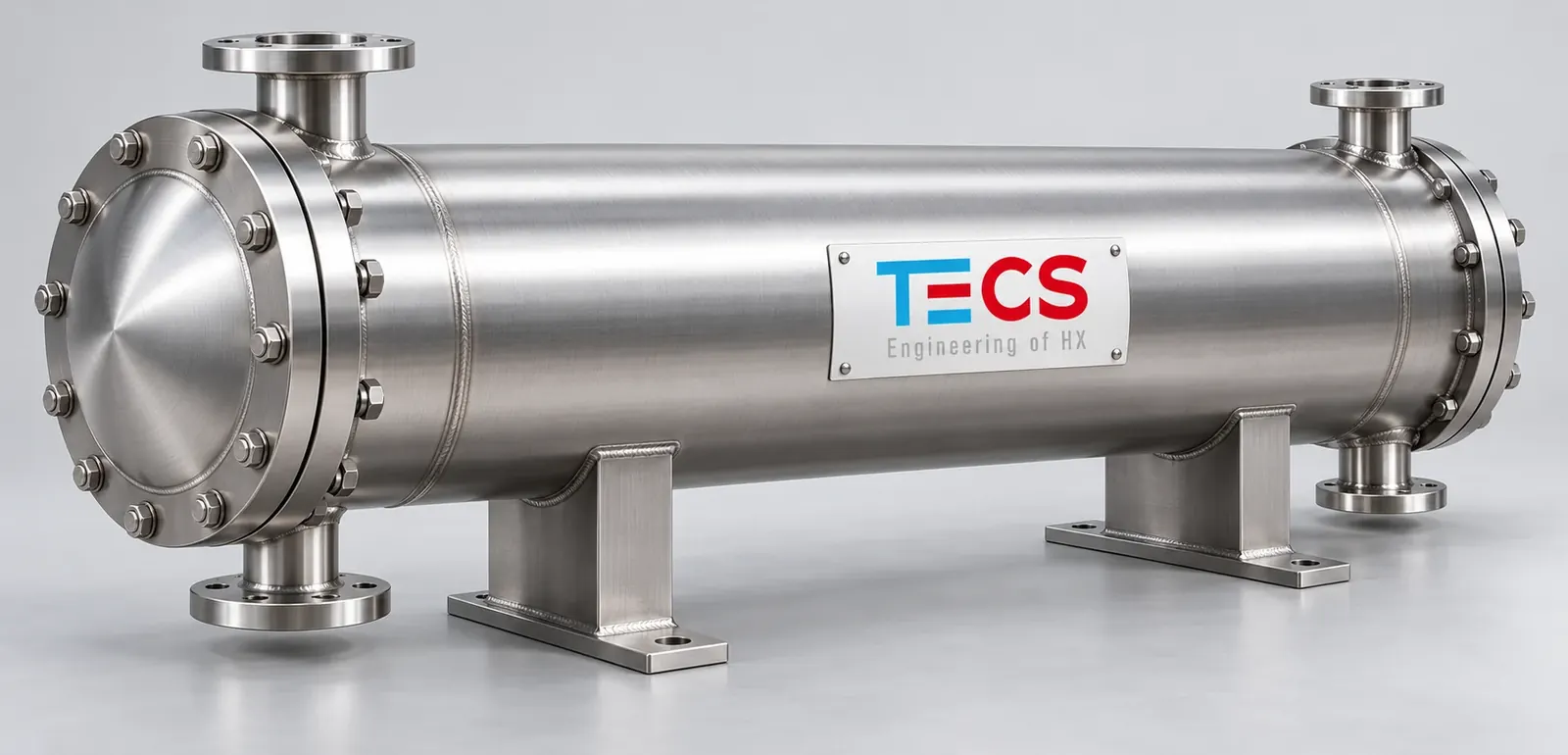
A bundle of tubes inside a cylindrical shell; one fluid through the tubes, the other around them, guided by baffles. It is the oldest design and still the standard where pressures are high, temperatures are extreme, fluids are dirty or one side is a gas or a condensing vapour. Oil coolers, fuel coolers, charge-air coolers with water, steam condensers and refinery exchangers are shell-and-tube.
It is larger and heavier than a plate unit for the same duty, but it tolerates fouling, can be cleaned mechanically, is built to pressure-vessel codes for any pressure, and the tube bundle can be replaced. TECS supplies shell-and-tube oil and fuel coolers alongside its radiators when the cooling package calls for them.
How An Engine Cooling System Uses All Three
A large engine rejects heat from its cylinders, its charge air, its lubricating oil and sometimes its fuel. Inside the engine package the oil and the charge air are usually cooled by the coolant in shell-and-tube or plate exchangers; the coolant then carries everything to the final air-cooled stage - the remote radiator or dry cooler - which hands the heat to the atmosphere. In a CHP plant a plate exchanger sits between the engine coolant and the heating network, and an emergency cooler takes over when the network cannot take the heat.
TECS designs the air-cooled stage and selects the plate and shell-and-tube units that belong to it, so that the whole circuit respects the engine maker's flows, temperatures and pressure drops. Send the engine data sheet or the process figures, and the proposal lists every exchanger in the package.
In Short
Air-cooled: liquid to air through finned tubes and fans; radiators, dry coolers, inlet coils
Plate: liquid to liquid across pressed plates; compact, efficient, moderate pressure
Shell-and-tube: tubes in a shell; high pressure, dirty fluids, gases and vapours
An engine package uses all three and ends in the air-cooled stage
TECS builds the air-cooled stage and supplies the oil, fuel and plate exchangers with it
Every exchanger in a package is selected to the engine maker's limits
For liquid to liquid, the plate heat exchanger gives the most heat transfer per unit of volume. For heat that must end in the atmosphere, only an air-cooled unit will do, and its efficiency is a question of surface and fan power. The right type is decided by the fluids, not by a ranking.
What is a radiator in these terms?
An air-cooled heat exchanger for the coolant of an engine: a finned tube coil with fans. Engine-mounted on the skid, or remote with electric fans when it stands apart from the engine.
Can a plate heat exchanger cool with air?
No; plate exchangers are for two liquids. Air needs the large surface of a finned tube coil. In an engine system the plate exchanger cools one liquid with another, and the air-cooled unit cools that other liquid with the atmosphere.
Why are oil coolers often shell-and-tube?
Oil is viscous and can carry debris; the tube side tolerates both and can be cleaned. Pressures are higher than plate gaskets like, and the shell-and-tube unit is built to the pressure code without special measures.
Does TECS build all three types?
TECS designs and builds the air-cooled heat exchangers - remote radiators, V-type units, inlet coils, heating modules - and supplies the plate and shell-and-tube oil, fuel and heat-recovery exchangers that belong to the same cooling package.
Send us the heat duty, the fluid temperatures and flow rates, the ambient conditions and the installation limits. We answer with a design proposal - or write to us on WhatsApp.